Getting a scoliosis diagnosis for yourself or your child can feel like the ground has shifted. The word alone carries weight. Images come to mind of braces, surgery, and a spine that will only get worse. Most of the time, none of that is where the story is headed.
Most people who are told “you have scoliosis” are hearing about a mild curve, one that will be watched, measured, and left alone unless it changes. I see this reaction every week in my practice, and the anxiety almost always comes from not knowing where a mild curve sits on the spectrum of this condition. Once patients and parents understand what “mild” means, the fear tends to settle into something manageable: a plan, not a crisis.
What Mild Scoliosis Means
Quick Answer:
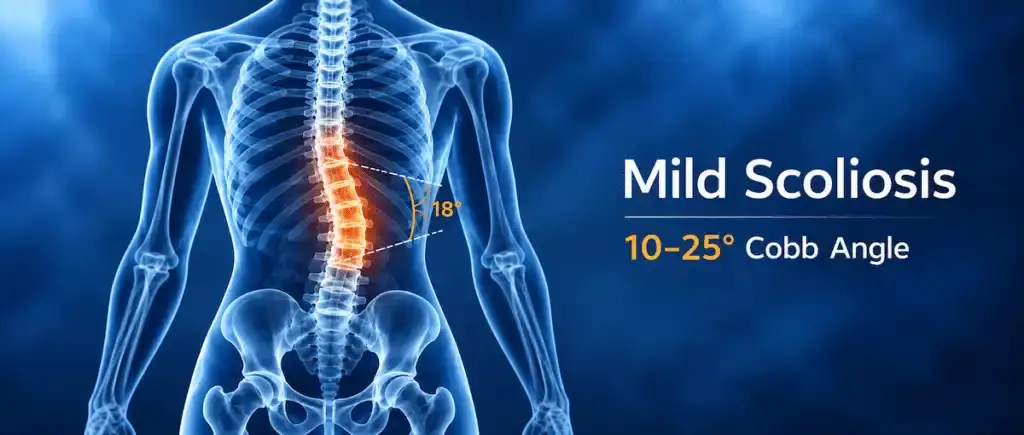
What counts as mild scoliosis? Mild scoliosis is a sideways curve of the spine measuring between 10 and 25 degrees on an X-ray, using a measurement called the Cobb angle. A curve under 10 degrees is considered normal spinal variation, not scoliosis. Mild curves seldom cause pain or visible deformity, and most are watched over time rather than treated.
The Cobb angle is how your doctor measures the amount your spine curves from side to side. It is not a judgment of how healthy your spine is, only a description of one curve, on one X-ray, at one point in time.
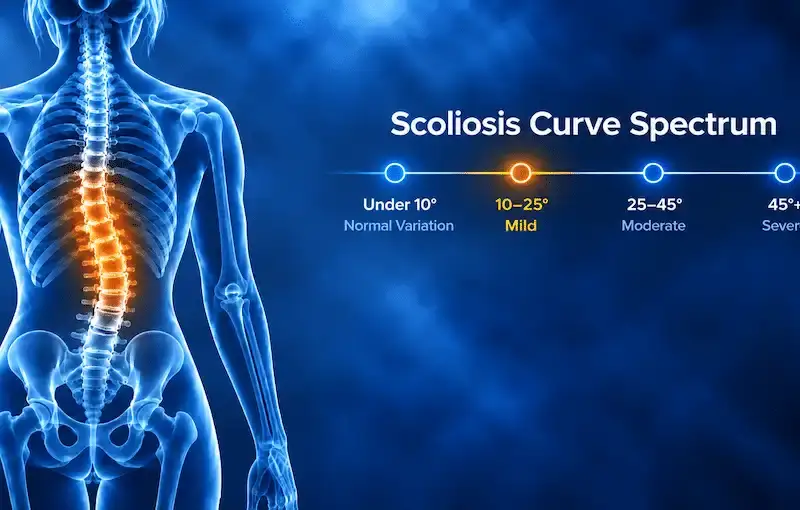
- Under 10 degrees: normal variation, not classified as scoliosis
- 10 to 25 degrees: mild scoliosis, observed rather than treated in most cases
- 25 to 45 degrees: moderate scoliosis, where bracing may be considered in a growing child
- Above 45 degrees: severe scoliosis, where surgery becomes part of the conversation
If you have a Cobb angle from a recent X-ray, hold onto it. That number, tracked over months or years, tells your doctor far more than any single snapshot.
Knowing where your curve falls on this scale is the first step. The next question almost every patient asks is harder: why did this happen?
What Causes Mild Scoliosis in Children and Adults
Quick Answer
What causes mild scoliosis? Most mild scoliosis is idiopathic, meaning it has no known cause. Idiopathic scoliosis accounts for roughly 80 percent of cases and tends to run in families. A smaller group of cases has an identifiable source: congenital scoliosis, which begins before birth; neuromuscular scoliosis, which develops alongside a muscle or nerve condition; and degenerative scoliosis, which appears later in life as the spine wears unevenly.
Idiopathic scoliosis is the most common form by a wide margin, and it shows up most often in children and teenagers. We cannot always trace it to one gene or event. What I can tell you is that it is not caused by backpacks, poor posture, sitting wrong at a desk, or anything a parent did or did not do. Parents often arrive in my office carrying guilt they never needed to pick up.
A smaller group of cases traces back to a cause we can name:
- Congenital scoliosis begins before birth, when one or more of the small bones of the spine do not form or separate the way they should
- Neuromuscular scoliosis develops alongside a condition that affects muscle control, such as cerebral palsy
- Degenerative scoliosis appears later in life, most often after age 50, as the discs and joints of the spine wear unevenly over time
Adults are sometimes surprised to learn they can develop a new mild curve well into their sixties or seventies. Degenerative curves behave differently than the idiopathic curves we see in growing children, and knowing which category a curve falls into shapes how closely it needs to be watched
How Mild Scoliosis Is Diagnosed
Quick Answer
How is scoliosis diagnosed? Scoliosis is diagnosed through a physical exam, often including the forward bend test, followed by a standing X-ray that allows a doctor to measure the Cobb angle. The X-ray confirms the diagnosis and establishes a baseline number that future visits are compared against.
During a physical exam, I look for uneven shoulders, an uneven waistline, or a rotated ribcage, the kind of asymmetry that shows up when a patient bends forward at the waist. This screening step, described by the American Academy of Orthopaedic Surgeons, points toward scoliosis but does not confirm severity on its own.
A standing X-ray does that work. It shows the true shape of the curve and lets us calculate the Cobb angle with precision. For a mild curve, that X-ray becomes the baseline every future image gets compared against.
- Physical exam and forward bend test as the first screening step
- Standing X-ray to confirm the diagnosis and calculate the Cobb angle
- Follow-up X-rays spaced months or years apart, depending on age and curve size
A diagnosis is not a sentence. It is a starting measurement, and what happens next depends on what that measurement is.
Why Observation Is the Right Plan for Most Patients
Quick Answer
Does mild scoliosis need a brace? Most mild scoliosis, under 25 degrees, does not need a brace. Bracing is generally reserved for curves between roughly 25 and 45 degrees in a child who is still growing. For a mild curve, the standard, evidence-based approach is observation: periodic X-rays to confirm the curve is stable.
The American Academy of Orthopaedic Surgeons identifies observation, bracing, and surgery as the three proven paths for treating scoliosis, and most patients never move past the first one. No medication, exercise routine, or brace has been proven to make a mild curve disappear, and none needs to be. The goal at this stage is to confirm the curve is not progressing.
Research published by the American Academy of Family Physicians reinforces this: mild scoliosis is most often symptom-free, with no evidence that it causes disability or loss of function.
- Growing children are checked every six months to a year in most cases
- Adults with a stable mild curve may only need imaging every few years
- A curve that stays under 25 degrees through skeletal maturity, the point at which the bones stop growing, seldom becomes a surgical concern later
I know observation can feel like doing nothing while you wait for bad news. It is closer to the opposite: monitoring is what catches a curve early if it does start to change.
Adults are the exception worth naming. If you have a mild curve alongside another spinal problem, such as arthritis pressing on a nerve or a segment that has become unstable, the curve can become part of a larger treatment conversation. In that situation the decision is driven by the other problem, not by the size of the curve. For a stable mild curve with nothing else going on, observation remains the plan.
And not every mild curve behaves, or looks, the same.
Not Every Mild Curve Looks the Same
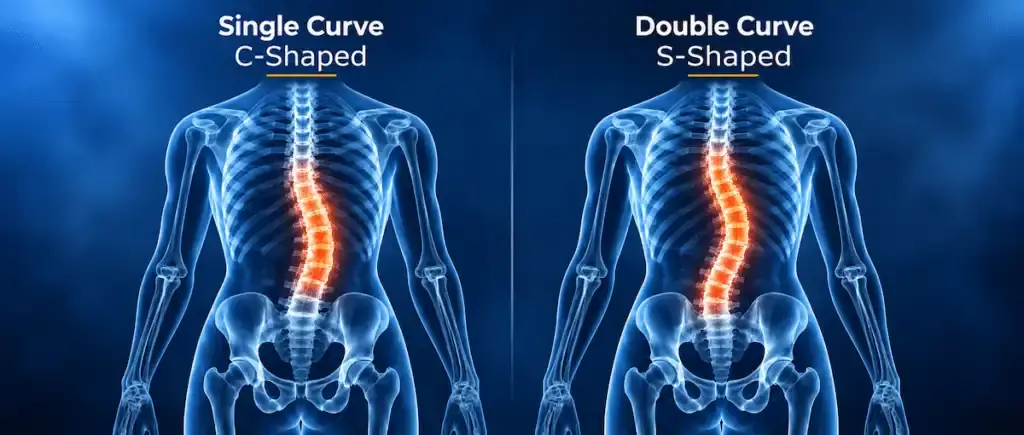
Quick Answer: What is the difference between a single curve and a double curve? A single curve bends the spine in one direction and forms a C shape, while a double curve involves two curves bending in opposite directions and forms an S shape. Double curves are sometimes called combined scoliosis. Both patterns can fall within the mild range, and the pattern itself does not determine how serious a curve is.
A Cobb angle tells you how big a curve is, but not what shape it takes or which direction it bends. Curves are described by direction and by pattern:
- Direction: a curve bending to the left is called levoscoliosis, while one bending to the right is called dextroscoliosis, the more common of the two
- Single curve pattern: one curve shaped like the letter C, most often in the thoracic spine (the upper and mid back) or the lumbar spine (the lower back)
- Double curve pattern: two curves working in opposite directions, shaped like the letter S, sometimes called combined scoliosis
Our guide to the different types of scoliosis curves walks through each pattern in detail.
None of these variations make a curve more or less “mild.” A 15-degree curve is a 15-degree curve whether it bends left or right, single or double. What changes is how your doctor describes it and what signs are worth watching for.
Signs a Mild Scoliosis Curve Needs a Specialist’s Eye
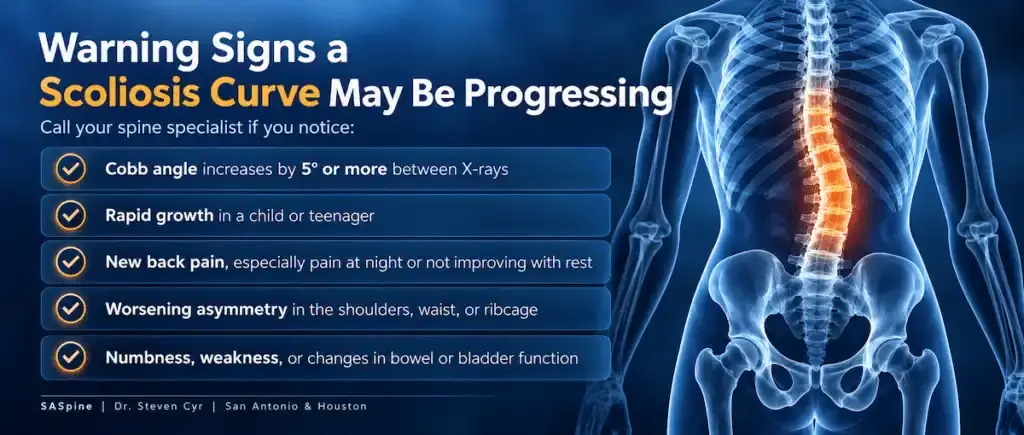
Most mild curves stay mild. A few changes are worth bringing to a doctor’s attention rather than waiting for the next scheduled visit:- A Cobb angle that increases by 5 degrees or more between X-rays
- Rapid growth in a child or teenager, since curves can progress fastest during growth spurts
- New back pain, in particular pain that wakes you at night or does not improve with rest
- A worsening asymmetry in the shoulders, waist, or ribcage
- Any numbness, weakness, or change in bowel or bladder function, which is rare but always warrants prompt evaluation
If a curve does progress beyond the mild range, options widen to include bracing and, for the largest curves, scoliosis surgery. That outcome is uncommon for curves that start out mild. Knowing the warning signs means you never have to wonder whether something has changed, because you and your doctor will be watching for it together.
Next Steps
A mild scoliosis diagnosis is information, not an emergency. Most curves in this range stay stable, get monitored on a simple schedule, and never require a brace or surgery. What matters is knowing your Cobb angle, understanding your curve’s pattern, and keeping up with the imaging that confirms nothing has changed.
If you or your child has been diagnosed with a mild curve and you want a second set of eyes on the X-rays, schedule a spine evaluation with our San Antonio or Houston office. We will walk through your imaging together and make sure you leave with a plan you understand, not just a number on a report.
FAQs
Does mild scoliosis get worse over time?
+Can mild scoliosis cause pain?
+Can mild scoliosis ever require surgery in adults?
+Does my child need a brace for mild scoliosis?
+How often will I need follow-up X-rays?
+Can exercises or physical therapy improve mild scoliosis?
+Medically reviewed by Dr. Steven J. Cyr